
Flip your dog's foot over and run a thumb across the big pad. On most dogs it feels like a well-worn sneaker sole: firm, a little grippy, smooth at the edges. On some it feels like bark. The surface is thick and dry, the rim is ragged, and there may be little bristly bits sticking out around the edge that look a lot like hair.
That bark texture has a name. Dog hyperkeratosis is the body making more keratin — the protein that builds skin, hair, and nails — than the spot can wear off, and it piles up on the paw pads, the top of the nose, or both. It's a vet diagnosis, not a grooming one. But feet and faces are a big part of any groom, so it's worth knowing what it looks like, what to ask your vet, and how it fits around an appointment.
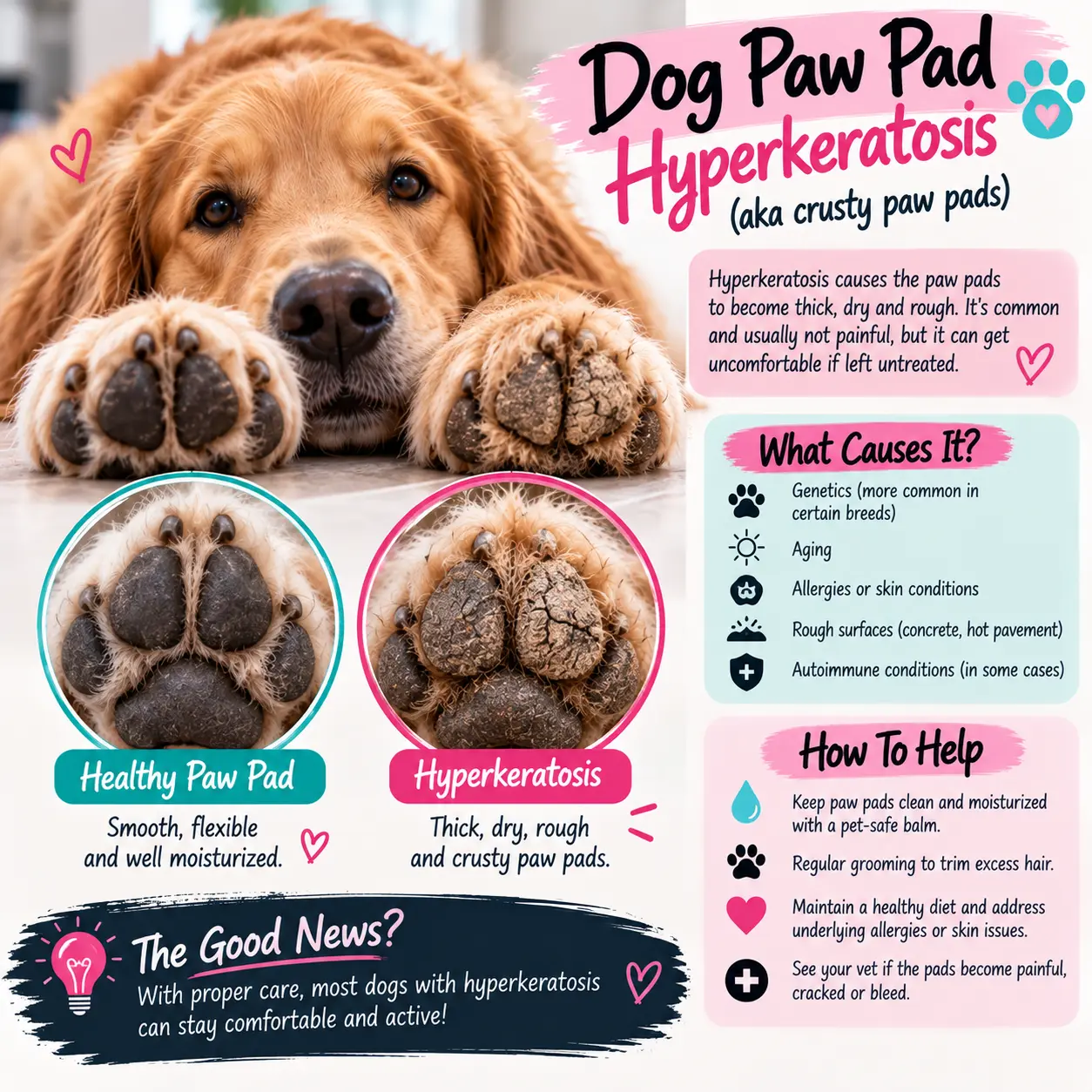
What you're looking at
According to PetMD's veterinarian-written guide, the extra keratin shows up as thickened, dry calluses on the pads, or as furry, hairlike projections growing off them. It can also show up on the bridge of the nose and on pressure points like the elbows. Cracked, dry skin is part of the picture. Limping is less common, and bleeding pads or a limp are the version that needs the vet sooner.
On the nose, it sits on top of the leather. Instead of the usual smooth, pebbled surface you get a hard, dry, crusty layer that can split.
The paw version is the one people miss, and the reason is usually hair. On a furnished foot — a Cocker, a doodle, a Shih Tzu — the hair between the pads grows down and covers them, so a rough pad can go months without anybody laying eyes on it. Those bristly bits around the rim don't help. They look so much like stray foot hair that it's easy to assume they're more of the same.
Hairlike, but not hair
This is where it touches grooming directly. The hair between the pads is coat; it can be trimmed, and whether to trim it is a call we went through in hair between your dog's paw pads. The feathery fringe of hyperkeratosis is pad. It's attached to living tissue, and it isn't something to cut, file, or pick at home on a guess.
Removing that extra growth can be part of the treatment. A veterinary dermatology client handout describes care as softening the dry tissue and occasionally trimming the excess. That's the vet's plan to make, though, including how much comes off and who does it. Too much, and you're into the skin underneath.
If you see it during a foot trim at home: stop, take a phone picture in good light, and leave it alone until the vet has had a look.
Which dogs get it
PetMD lists flat-faced breeds — English and French Bulldogs, Boston Terriers, Pugs, Boxers — plus Labrador Retrievers, Cocker Spaniels, Irish Terriers, and Dogues de Bordeaux as dogs where it's common. Some of those are about genetics. Some are about mechanics: a short-nosed dog rubs its face against the bowl at every meal, and a foot that doesn't land flat wears unevenly. Age plays in too. The same source notes elbow calluses turning up in senior dogs, often around 8 to 12.
Most cases come down to genetics or age. Not all of them, though. PetMD names autoimmune skin disease, Cushing's disease, canine distemper, and zinc deficiency as other possible causes, which is the main reason a crusty nose goes to the vet instead of straight to a balm. Your vet can tell the harmless callus from the version that's a symptom of something else, and may want bloodwork or a skin sample to do it.
Is it the cold, or is it this?
Winter adds a look-alike. Salt and ice melt crack pads too, and a dog with a sore foot after a January walk isn't automatically a hyperkeratosis dog. We covered the road-salt side in winter paw care.
A few things to write down for the vet:
- Where it is. Salt cracking follows where the dog walked. Hyperkeratosis is thick and built-up, and when the nose has it too, a sidewalk is a hard explanation to make fit.
- When it showed up. Cracks that appeared after a week of treated sidewalks tell a different story than a thickening that was already there in August.
- The fringe. Bristly, hairlike growth around the pad's edge isn't a salt injury.
Either way, anything bleeding, swollen, or making your dog limp is a vet call, not a wait-and-see.
Living with it between appointments
The handout above calls it lifelong, something that's managed instead of cured, and PetMD says most affected dogs live long, comfortable lives with it. Plenty of mild cases need very little. When care is needed, it usually comes down to softening. Depending on your dog, a vet may suggest:
- A balm on the pads and nose. PetMD recommends a moisturizing balm on pads, nose, and elbows; ask your vet which one, since your dog will lick some of it off.
- A medicated shampoo aimed at softening thick skin.
- Ointments, and for infected cracks, antibiotics only a vet can prescribe.
- Softer bedding, for the senior dog with calluses on the elbows.
Once things are under control, the handout puts upkeep at once or twice a week for some dogs, and only now and then for others, as the growth comes back. Watching for change is the other half: new spots, cracks that open up, or a dog who starts favoring a foot all go back to the vet.
Bringing a dog with hyperkeratosis in for a groom
Tell us at drop-off. Feet and faces are hands-on work, and it helps to know what we're looking at before we pick up a paw.
A few things worth mentioning:
- What your vet said. If there's a treatment plan, it's useful for us to know it.
- Any balm you're using, and when you last put it on. It's easier to plan the foot work knowing the pads are coated.
- A medicated shampoo, if one's been prescribed. Ask whether it fits into the bath, and bring it along.
- Sore spots. A dog with a cracked pad will pull that foot back, and knowing which one helps.
We'll tell you what we see when we're done — a rim that looks thicker than last time, a crack that's new, a nose that's changed. You decide what to do with that, and your vet decides what it means. Keeping the foot hair tidy between visits helps too, since it's a lot easier to notice a change on a pad you can see. For older dogs with a few of these issues stacking up, our senior dog grooming guide covers how appointments can be adjusted.
If your dog's feet could use a trim and a closer look, book a groom with us and mention the pads when you do.